

One of our most fundamental needs is food – sufficient, nutritious, safe, and affordable. For 50 years or more, with a few notable and persistent exceptions, we have all benefited from the remarkable output and advances of our modern food system. Notwithstanding these accomplishments, our food production system is increasingly being stressed. Indeed, over the next few decades, demand for food is forecast by many to grow faster than supply.

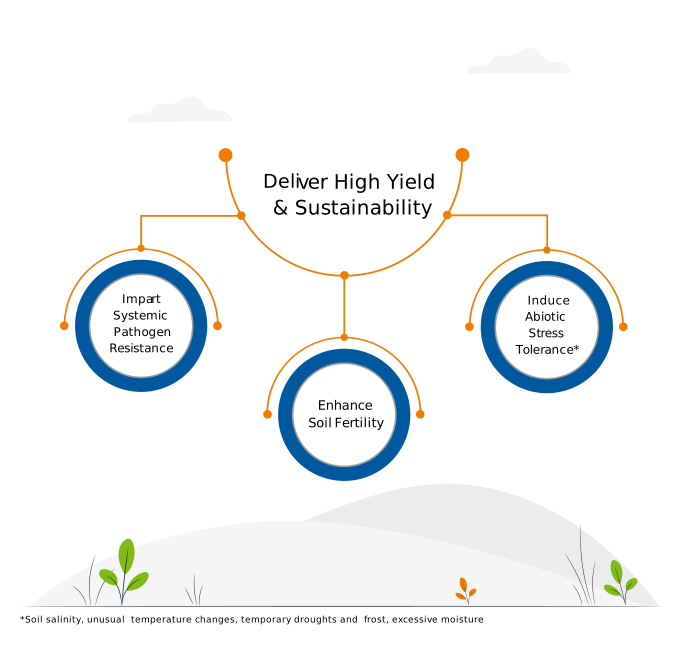
Measurable & visible results of IEC Applications can be observed in less than 3 weeks me. Whether it’s decomposition of Organic matter, conversion of wasteland in to fertile land, balancing of soil pH, soil or air borne fungal attack or control of virus in some crops, suppression of odour, flies and Methane in Municipal Solid Waste Dump Sites, or drying of MSW, or improving Milking Efficiency in Dairy animals, it takes only 2-3 weeks. Generally, all such problems cannot be addressed fully or crops cannot be effectively recovered by conventional methods or it can be addressed in such a short time.
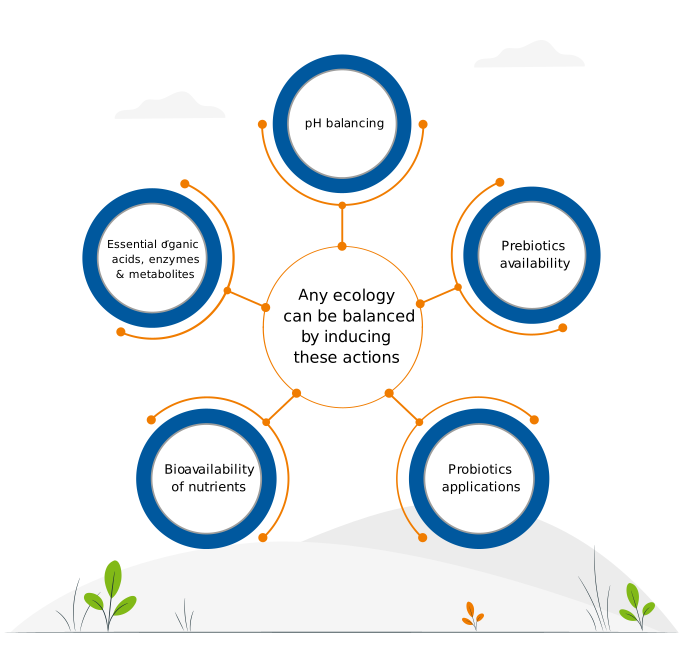
IEC technology creates a synergy with Natural Forces. In Agriculture, First, it balances soil pH to thwart growth of undesirable microbes, & at the same time, it provides Prebiotics & Probiotics to enhance local beneficial microbial colonies. Every ecology has its own microbial profile, based on the nutrient availability & environment. These local microbes are most capable of managing nutrient cycling. Nutrient cycling involves availability of macro & micro nutri on, availability of trace elements, dominance of beneficial microbes, presence of metabolites, natural enzymes & amino acids etc. NPB Technology ensures balancing of Vegetative Growth : Vegetative and Reproductive growth. At the same me, it also ensures bioavailability of nutrients (macro, micro & trace) along with metabolites, natural enzymes & amino acids etc to enhance immunity towards biotic & abiotic stress.
IEC’s Secondary Culture (SC) is a unique applicative procedure introduced to make the economics of agriculture more sustainable and to increase the longevity of restoration of dynamics at the site of application.
It involves a process of culturing the Proprietary Culture INNO-CARE with locally available resources. This procedure provides the farmer the benefit of multiplying the INNOCARE culture by 1000 times in volume and up to 1X10¹³ microbes per ml of SC, hence providing a monetary benefit.
Another important aspect of this SC is that this culture is multiplied by involving the local components such as sugar/Molasses/farmsoil/animal dung etc. which multiplies the culture and produces biochemicals, metabolites and precursors for the activation and growth of local microorganisms sourced from soil and animal dung, and eventually enriches the soil microbiota, Increases carbon turn-over in soil, Improves water holding capacity of the soil, Improves mobility of nutrients and improves vigor.











 About Agriculture